
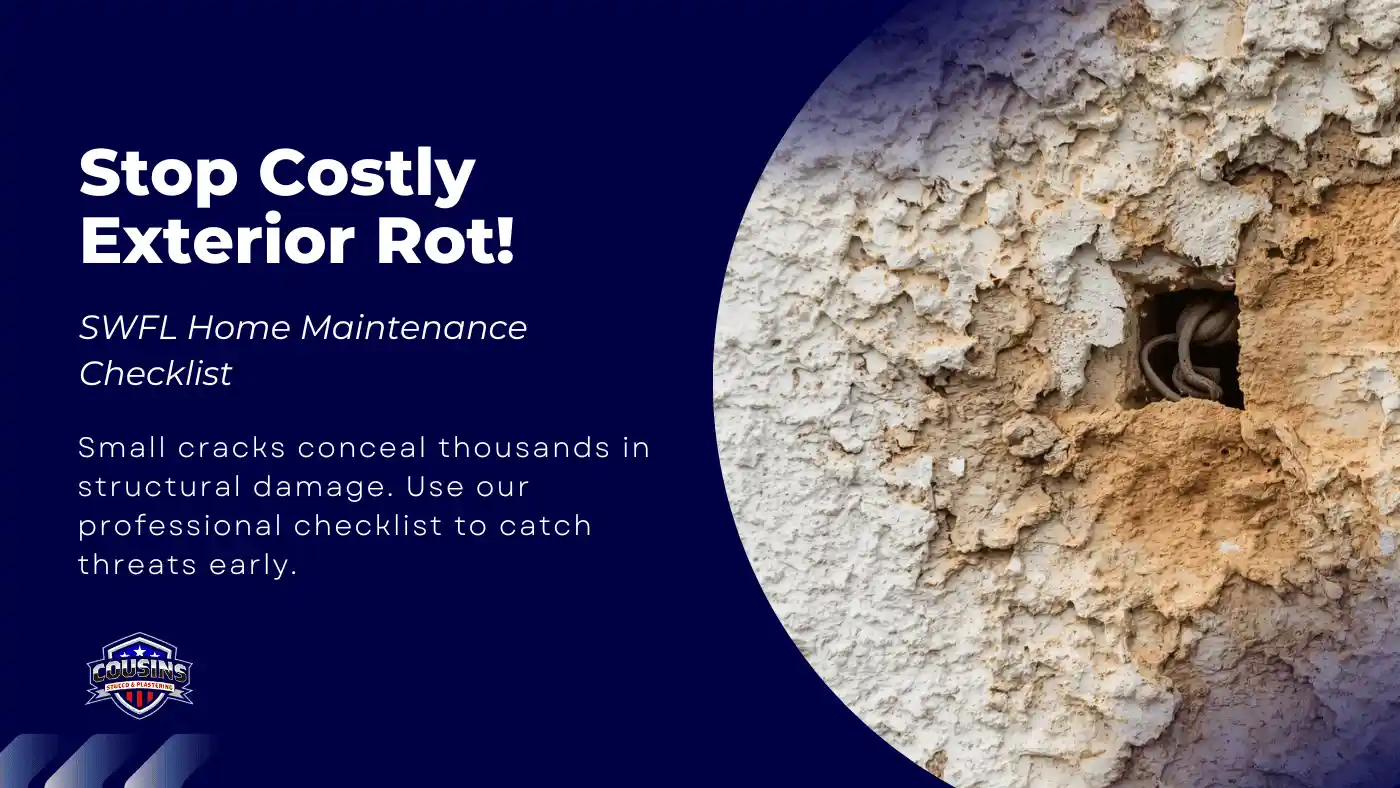
Your home’s exterior is its first line of defense against the relentless heat, salt air, and heavy tropical downpours of Southwest Florida. While stucco is incredibly durable, it is not a “set it and forget it” material. Following a proactive stucco maintenance checklist for swfl homes is the single most effective way to protect your investment and avoid the massive expenses associated with structural water damage and mold remediation.
At Cousins Stucco, our licensed and insured team has seen firsthand how small cracks can turn into five-figure headaches if left untreated. This guide provides a strategic roadmap to keep your exterior in peak condition.
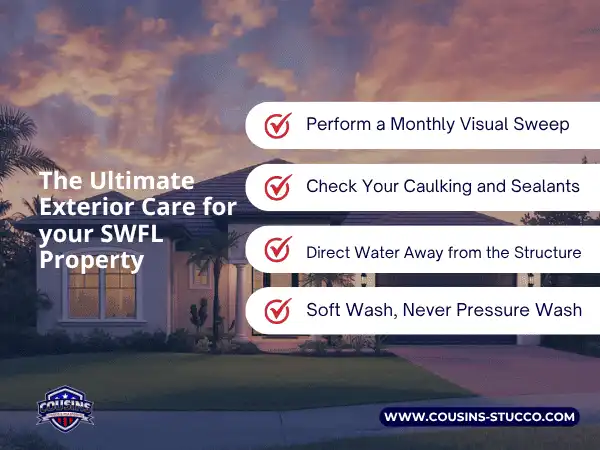
The Ultimate Exterior Care Plan: Protecting Your SWFL Property
1. Perform a Monthly Visual Sweep
Start with a slow walk around your property once a month. Pay close attention to the bottom casing bead near the foundation, along the structural termination line, and around windows and doors. You are looking for:
- Hairline Cracks: These are common due to building settlement but can act as straws that suck moisture behind your walls.
- Discoloration: Dark or brownish stains are often marks on your stucco, signaling that water is getting trapped.
- Efflorescence: That white, chalky powder appearing on your walls is actually mineral salt left behind by evaporating moisture—a major red flag.
2. Check Your Caulking and Sealants
In the Florida sun, caulking can dry out, shrink, and crack within just a few years. Inspect the seals around every window, door, and outdoor light fixture. If the caulk is pulling away or feels brittle, it is no longer doing its job. Replacing a $10 tube of high-quality sealant today can prevent a $2,000 localized repair later.
3. Direct Water Away from the Structure
The intense rain we experience in Naples, Fort Myers, and Cape Coral puts immense pressure on your building envelope.
- Gutters: Ensure they are clean and that downspouts terminate several feet away from the house.
- Sprinklers: Adjust your irrigation heads so they are not constantly spraying directly against your stucco walls. Repeated soaking will eventually break down the protective paint barrier.
4. Soft Wash, Never Pressure Wash
Dirt and salt buildup can degrade your stucco over time, but a high-pressure power washer can blast right through the finish. Use a garden hose and a soft-bristle brush with mild detergent to clean your walls once or twice a year. This keeps the colors vibrant and allows you to spot small issues that might be hidden by dirt.
Why Professional Stucco Care Matters
While DIY checks are vital, some issues are invisible to the naked eye. Moisture can hide within EIFS layers applied over DensGlass or adequate, non-combustible sheathing, or deep within traditional cement fields long before a stain appears on the surface.
Hiring a licensed and insured specialist like Cousins Stucco ensures that repairs are handled according to Florida building codes. We map out all exterior systems using rust-proof vinyl accessories (trims, beads, and control joints). We also use specialized moisture meters and infrared tools to verify that your walls are truly dry before we seal them, preventing you from accidentally locking in a moisture problem.
Frequently Asked Questions (FAQ)
How often should I repaint my stucco in Florida?
For most SWFL homes, we recommend a high-quality elastomeric paint every 5 to 8 years. These paints are designed to bridge small cracks and stretch as the home expands and contracts in the heat.
Are small cracks a big deal?
Even a crack the width of a credit card can allow driving rain to penetrate your moisture barrier. In the humid Florida climate, that trapped water can lead to mold growth behind your walls in as little as 48 hours if the bottom termination line is blocked.
How much does stucco repair cost if I wait?
Minor patching and crack filling usually cost between $500 and $2,000. However, if water migrates past the termination line and compromises the underlying lath matrix, full remediation can easily exceed $20,000. Prevention is always the cheaper option.
Can I use regular caulk for repairs?
We recommend using a professional-grade masonry sealant or a specialized stucco patch. Regular silicone caulk often doesn’t bond well with the porous texture of stucco and may fail prematurely in the UV light.
Does salt air affect my stucco maintenance routine?
Absolutely. If you live within five miles of the coast, salt crystals can accumulate in the pores of your stucco, attracting more moisture. Homeowners in coastal areas should rinse their walls with fresh water more frequently to prevent salt degradation.
Don’t wait for a stain to appear on your ceiling. Is your home overdue for a professional checkup? Contact Cousins Stucco at (239) 744-2630 to schedule an expert inspection and ensure your home stays beautiful and dry all year long.