Your Naples home says a lot before you ever open the front door. The texture on your walls, the way afternoon light catches a roughcast pattern, the clean geometry of a smooth finish—all of it communicates something about the property’s value, its character, and the care that’s gone into it. If your exterior is looking tired, chalky, or just plain dated, the right stucco finish isn’t just cosmetic—it’s one of the most impactful investments you can make in your home’s curb appeal and long-term durability.
Southwest Florida’s climate is notoriously unforgiving. Between the salt air rolling in off the Gulf, the punishing UV index, hurricane-force wind events, and summer humidity that makes you feel like you’re walking through warm soup, your exterior wall system has to work hard every single day. Choosing the right finish—and getting it applied correctly—means the difference between a stunning exterior that holds up for decades and a patchy, moisture-damaged mess that’s embarrassing to look at.
So let’s break down the top three exterior stucco finishes that Naples homeowners are using to elevate their properties right now.
1. Sand Float Finish: The Classic That Never Goes Out of Style
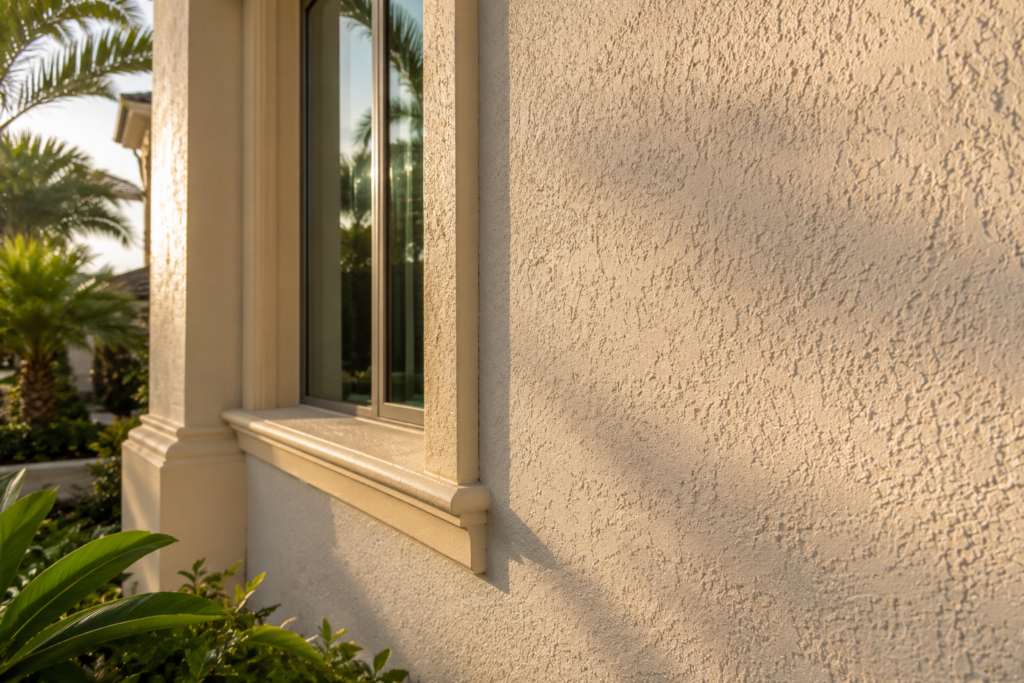
If you’ve driven through a Naples neighborhood built anytime in the past 50 years, you’ve seen sand float. It’s the workhorse of Southwest Florida stucco finishes—a slightly textured surface created by floating a sand-aggregate mortar to produce a consistent, matte appearance that reads as elegant without being fussy.
The sand float finish is applied as the final coat over a fully cured base coat system, and when done properly by an experienced contractor, it delivers outstanding uniformity. The aggregates in the mix create subtle peaks and valleys that add visual depth, break up flat light, and—critically—help disguise minor surface imperfections or future hairline cracking that’s just part of life in a climate with dramatic seasonal moisture swings.
Why Naples homeowners love it:
- It pairs beautifully with Spanish Colonial, Mediterranean Revival, and contemporary coastal architecture
- It takes exterior-grade paint and pigmented finish coats exceptionally well
- Mild texture means dirt and salt deposits don’t grip the surface as aggressively as coarser finishes
- It’s cost-effective compared to specialty finishes while still delivering a high-end result
From a technical standpoint, a properly executed sand float system over concrete masonry construction involves a scratch coat, a brown coat, and then the sand float finish coat—a three-coat process that, when cured and sealed correctly, creates a robust, breathable wall assembly. Your contractor should be installing vinyl casing beads and termination beads at every window, door, and termination line to ensure clean, defined edges and to manage movement at penetrations. Control joints and expansion joints placed at structurally appropriate intervals help prevent stress cracking from thermal expansion—something Naples homes see constantly as temperatures and humidity cycle throughout the day.
The result? A finish that looks intentional, holds up to the elements, and photographs beautifully when it’s time to list the property.
2. Smooth Finish (Venetian or Burnished): Modern Luxury Done Right
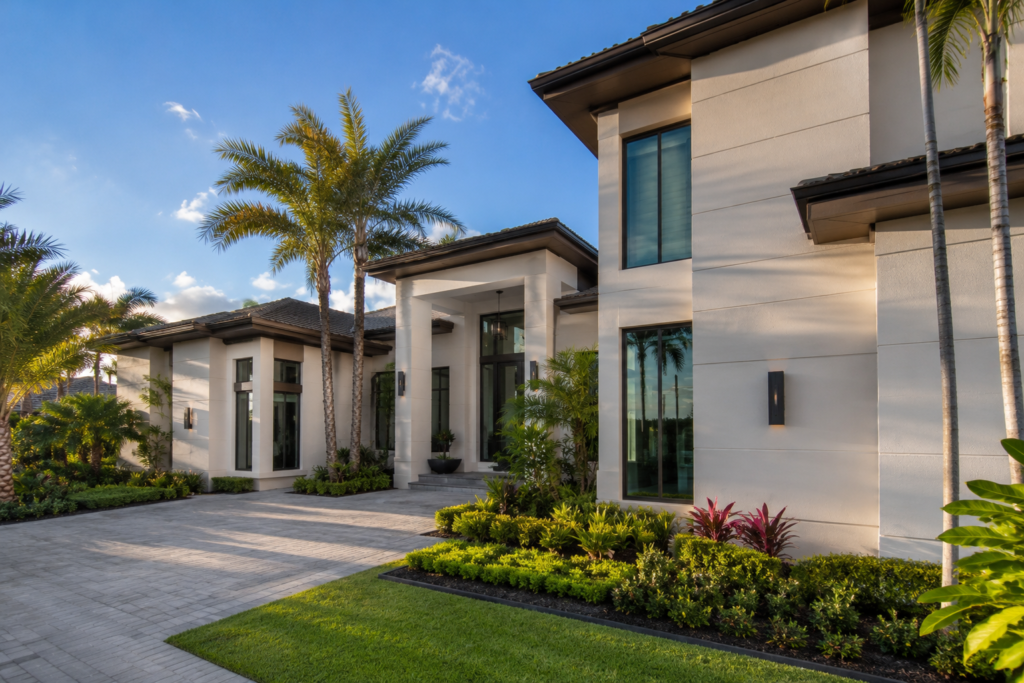
If sand float is the classic, smooth finish is the showstopper. Right now, smooth or near-smooth exterior stucco finishes are having a serious moment in Naples and across Collier County, driven by the surge in contemporary and transitional architecture that’s reshaping the city’s newer neighborhoods and beachfront estates.
A smooth or burnished finish is achieved by applying and then troweling the finish coat to a tight, compressed surface—minimizing or essentially eliminating visible texture. The result is a clean, monolithic wall plane that looks razor-sharp in photographs, creates dramatic shadow lines at architectural reveals, and gives a home an unmistakable high-end presence.
Here’s the honest truth, though: smooth finishes are unforgiving. Any substrate irregularity, any inconsistency in moisture content during application, any shrinkage cracking—all of it is visible in a way that a textured finish simply isn’t. That’s why this finish demands an experienced applicator who understands proper substrate preparation, curing windows, and mix proportions. Trying to cut corners here will result in a finish that looks worse than if you’d never done it at all.
What makes smooth finish worth it:
- Visually striking contrast with glass, metal, and dark trim elements common in contemporary Naples design
- Easy to clean—salt, pollen, and dust wipe or rinse away cleanly
- Reflects light in a way that makes even modest square footage look architecturally grand
- Commands higher perceived property value in luxury real estate markets
Proper accessory installation becomes even more critical with smooth finishes. Vinyl casing beads at every penetration, reveal beads creating shadow line details across large wall planes, and precisely placed expansion joints all become visible design elements—not just functional ones. Done right, they look deliberate and sophisticated. Done sloppily, they look like an afterthought.
For homes in the Fort Myers and Naples corridor that are targeting a contemporary or modern coastal aesthetic, a smooth finish over a properly cured CMU substrate is one of the most powerful curb appeal upgrades available.
3. EIFS (Exterior Insulation and Finish System): Energy Efficiency Meets Design Flexibility
EIFS gets a bad reputation in some circles, usually from people who encountered poorly installed systems years ago before the industry matured. Today’s EIFS—especially when specified and installed correctly—is a high-performance exterior cladding system that offers something traditional stucco simply can’t match: continuous exterior insulation.
In a Naples climate where air conditioning costs are a year-round reality, that matters more than people realize.
EIFS consists of an insulation board adhered or mechanically fastened to the substrate, a reinforced base coat applied over fiberglass mesh, and a finish coat applied over that base. The finish coat options are where the design flexibility becomes remarkable. You can specify textures that mimic fine sand float, smooth burnished plaster, coarse dash, Tuscan travertine, and dozens of other profiles—all within the same system. For a Naples estate looking to achieve a specific architectural aesthetic with a thermally superior wall assembly, EIFS delivers.
“EIFS, when properly engineered and installed, isn’t just a finish—it’s a complete exterior wall performance system that manages thermal, moisture, and aesthetic demands simultaneously.”
From a moisture management standpoint, modern EIFS utilizes an integrated drainage track at the termination line that allows any incidental moisture that penetrates the system to exit cleanly at the base of the wall. The system drains seamlessly over its integrated drainage plane without compromising the wall assembly’s performance. When the system is terminated correctly at grade with vinyl termination beads and casing beads at all openings, you’ve got a wall that handles Florida’s relentless weather events with genuine engineering behind it.
Where EIFS excels for Naples estates:
- Provides continuous thermal insulation that traditional three-coat stucco cannot replicate
- Allows complex architectural profiles—keystones, cornice details, decorative moldings—to be fabricated directly into the system
- Available in essentially unlimited texture and color profiles
- When properly installed over CMU construction, the system is specified using a traditional stucco core beneath the EIFS finish coat, creating a robust multi-stage assembly that’s both structurally sound and code-compliant
For homeowners in Cape Coral or Fort Myers considering EIFS for a renovation or new construction project, always ask your contractor about the system manufacturer’s specifications and how the drainage plane at the base of the wall is handled. A contractor who can answer that question fluently knows what they’re doing.
How to Choose the Right Finish for Your Naples Home
You’ve got three serious options on the table. Here’s a quick framework for narrowing it down:
| Finish Type | Best For | Texture Level | Maintenance Level | Thermal Performance |
| Sand Float | Mediterranean, Spanish Colonial, Traditional | Low-Medium | Low | Standard |
| Smooth/Burnished | Contemporary, Modern Coastal, Transitional | Minimal | Low-Medium | Standard |
| EIFS | All styles, energy-conscious builds, custom profiles | Highly Customizable | Low | Superior |
A few honest guidelines:
- If your home is a traditional Mediterranean or Spanish Colonial and you want a timeless result with straightforward maintenance, sand float is your answer. It’s proven, it’s beautiful, and it works in Florida’s climate without drama.
- If you’re renovating a contemporary home or building new with a modern coastal aesthetic, smooth finish is worth the premium—but only if you’re hiring a contractor with real experience applying it. The skill gap between average and excellent is enormous with this finish.
- If energy efficiency is a genuine priority, or if you’re working on a home with complex architectural detailing that would be prohibitively expensive to execute in traditional stucco, EIFS is the technically superior choice. Get the system specified properly and make sure installation follows the manufacturer’s requirements down to every termination bead placement.
One thing that applies across all three: don’t neglect your termination lines and control joints. Regardless of which finish you choose, proper placement of casing beads at openings, termination beads at every edge and grade transition, and expansion joints across large continuous wall planes is what separates a wall system that performs for 30 years from one that starts cracking and failing within five.
Naples and the broader Collier County area get enough tropical weather events each year that moisture management in your wall assembly isn’t optional—it’s the whole game.
Conclusion
The exterior stucco finish you choose for your Naples estate is a decision that touches everything—curb appeal, property value, energy performance, and long-term structural integrity. Sand float brings timeless texture and proven durability. Smooth finish delivers contemporary luxury that stops traffic. EIFS delivers design flexibility and thermal performance that no traditional system can match.
All three are excellent choices when specified and installed correctly. All three can fail spectacularly when they’re not. The most important variable in this equation isn’t the product—it’s the contractor’s knowledge, craftsmanship, and commitment to doing the technical work properly.
Frequently Asked Questions
What is the most durable exterior stucco finish for Southwest Florida’s climate?
All three finishes covered here can be highly durable in Southwest Florida when properly installed. The key factors are substrate preparation, correct mix proportions, proper curing time, and accurate accessory placement—particularly at termination lines and control joints. EIFS with a properly engineered drainage plane tends to offer superior moisture management in extreme climates.
How long does a stucco finish last on a Naples home?
A properly applied stucco system on a CMU substrate in Southwest Florida can last 20 to 50 years with routine maintenance. Factors that shorten lifespan include incorrect accessory installation, skipped curing steps, improper paint or coating selection, and deferred repair of cracks or impact damage.
Is EIFS appropriate for Florida homes?
Yes—modern EIFS is well-suited to Florida construction when properly specified and installed. It provides continuous insulation that helps with energy costs year-round and offers design flexibility that traditional stucco can’t match. The system must be properly terminated at grade with appropriate casing beads and termination beads, and the drainage plane must be correctly integrated.
What causes exterior stucco to crack in Naples?
Common causes include thermal expansion and contraction from Florida’s temperature and humidity cycling, missing or improperly placed expansion joints and control joints, substrate movement, and settling. Proper joint placement during initial installation significantly reduces stress cracking over the life of the system.
How much does a professional stucco finish or restoration cost in Naples?
Costs vary considerably based on the finish type selected, the size of the home, substrate condition, and the extent of any repair or preparation work needed. EIFS and smooth finish applications generally carry a premium over sand float due to material costs and skill requirements. Contact a licensed Southwest Florida stucco contractor for an accurate project estimate.
If you’re ready to transform your Naples estate’s exterior—whether that means a complete re-stucco, a targeted repair, or an EIFS upgrade—the team at Cousins Stucco is ready to help. Serving homeowners and property owners across Lee and Collier Counties, including Naples, Fort Myers, and Cape Coral, Cousins Stucco brings the technical expertise, craftsmanship, and local knowledge your project deserves. Reach out today for a professional consultation and let’s talk about what the right exterior finish can do for your home.