
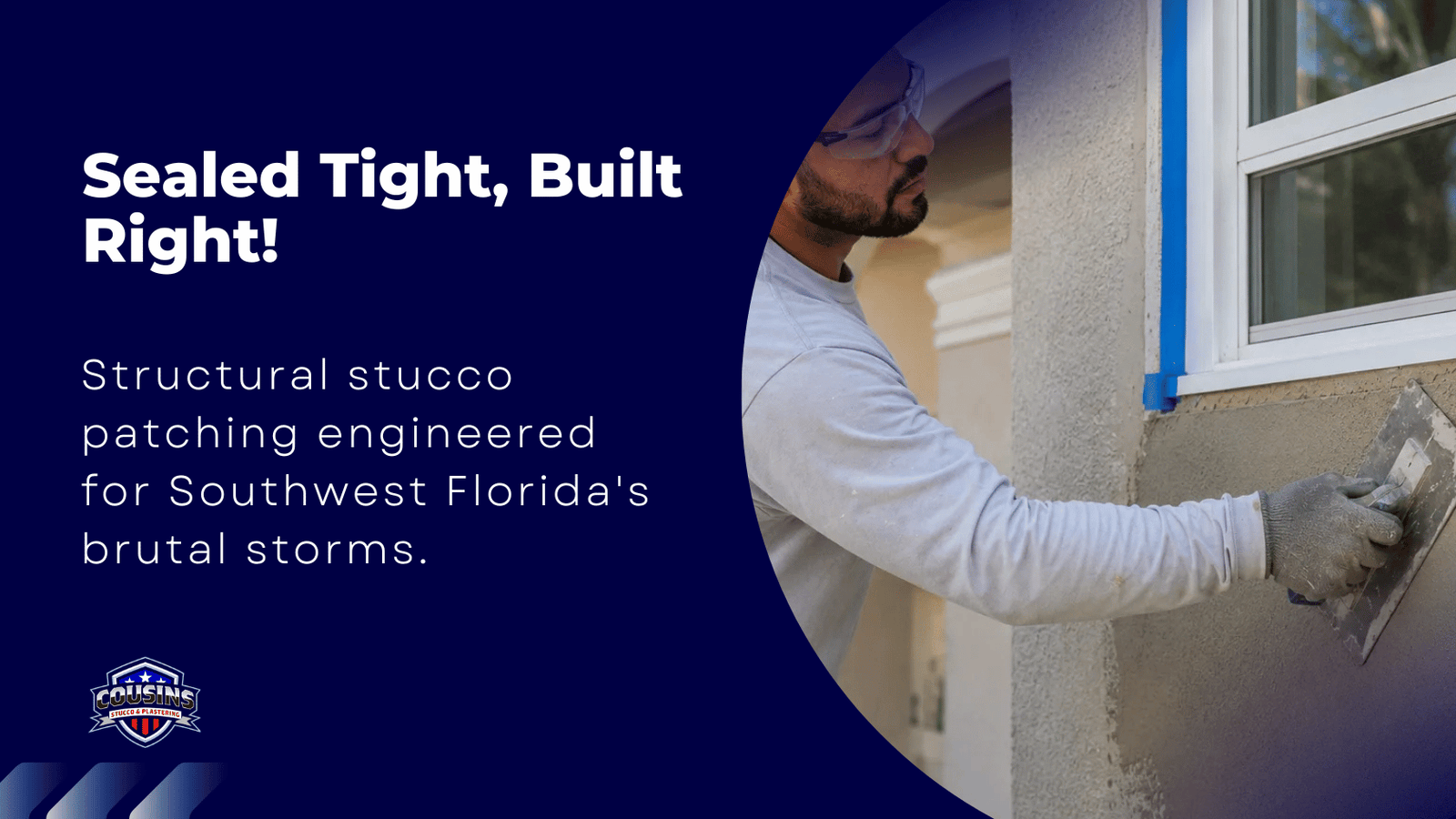
A leaking window during a Southwest Florida storm is often a sign that the exterior wall assembly around the opening has been compromised—not necessarily that the window itself has failed.
In Naples, Fort Myers, Bonita Springs, and surrounding communities, repeated exposure to wind-driven rain, high humidity, and intense heat can allow moisture to enter through cracks or deteriorated joints surrounding a window. If left untreated, water intrusion may lead to stained drywall, mold growth, damaged framing, and deterioration of adjacent building materials.
While applying new caulk may temporarily reduce water intrusion, lasting repairs often require addressing the surrounding stucco system and the weather-resistive barrier behind it.
Why Stucco Windows Leak in Southwest Florida
In many cases, the glass and window frame are not the source of the problem. Water commonly enters where the exterior stucco system meets the window opening after years of weather exposure and normal building movement.
Hairline cracks, failed sealant joints, or deterioration of the weather-resistive barrier can allow moisture to reach the wall assembly during heavy rain or hurricane-force winds.
Driving Rain → Exterior Cracks or Failed Sealant → Moisture Behind Stucco → Interior Water Damage
Because Southwest Florida experiences frequent tropical weather, these vulnerable areas should be inspected before moisture causes more extensive damage.
Why Surface Caulking Is Often Only a Temporary Solution
Applying caulk over visible cracks may reduce water intrusion for a short time, but it does not always address the source of the problem.
A surface repair cannot:
- Correct damage behind the stucco finish
- Replace deteriorated weather-resistive barrier materials
- Remove trapped moisture already inside the wall assembly
- Prevent future cracking caused by normal structural movement
When moisture has entered behind the stucco, the affected section typically needs to be opened so the underlying components can be properly evaluated.
What Happens When Window Leaks Are Left Untreated
Even a minor leak can allow moisture to remain inside the wall for extended periods.
| Area | Possible Damage |
| Drywall | Water stains, bubbling paint, mold |
| Insulation | Moisture saturation |
| Wood Framing | Rot and deterioration |
| Interior Finishes | Peeling paint and moisture damage |
| Stucco Finish | Cracks, separation, or delamination |
Early repairs help reduce the risk of more extensive restoration work later.
Our Structural Stucco Repair Process
Each repair begins with identifying the affected section of the exterior wall and rebuilding the stucco assembly where necessary.
Inspection → Controlled Stucco Removal → Weather-Resistive Barrier Repair → Stucco System Restoration
1. Controlled Stucco Removal
The damaged stucco surrounding the window is carefully removed using specialized equipment that minimizes disruption to adjacent finishes.
This allows us to inspect the wall assembly and determine whether the weather-resistive barrier has been compromised.
2. Weather-Resistive Barrier Inspection and Repair
Once the wall is exposed, we evaluate the existing air and water barrier system.
Where needed, deteriorated materials are replaced with approved weather-resistive barrier products such as:
- 15 lb asphalt felt (building paper)
- Jumbo Tex 60-minute building paper
- Tyvek® or comparable weather-resistive barriers
Restoring these materials helps provide continuous protection behind the stucco system.
3. Reinforcement Installation
The reinforcement method depends on the wall assembly.
When repairs involve wire lath, fiber-reinforced mesh is installed over the lath to provide additional reinforcement before the stucco system is rebuilt.
For repairs over CMU block or concrete substrates, reinforcement methods differ and fiber mesh is not installed over the wall surface.
4. 3 Coat Stucco System
After the wall assembly has been repaired, the affected area is rebuilt using a traditional 3 coat stucco system.
Scratch Coat
The first coat establishes the initial bond with the prepared substrate.
Brown Coat
The second coat creates a flat, uniform surface while building thickness.
Finish Coat
The final coat is texture-matched to blend with the existing exterior finish.
Understanding Moisture Management in Stucco Systems
Traditional stucco is not a drainage system.
Its primary role is to provide a durable exterior finish while the weather-resistive barrier behind the stucco helps protect the wall assembly from moisture intrusion.
EIFS systems differ because they incorporate a vertical drainage plane designed to direct incidental moisture downward behind the finish.
Maintaining the integrity of the weather-resistive barrier is one of the most important aspects of long-term moisture protection.
Materials Used for Durable Repairs
Southwest Florida’s climate demands materials capable of handling heat, humidity, UV exposure, and seasonal storms.
Depending on the repair, materials may include:
- Weather-resistive barrier membranes
- 15 lb building paper
- Jumbo Tex 60-minute building paper
- Tyvek® weather barrier
- Fiber reinforcement over wire lath applications
- Elastomeric or polyurethane sealants for accessory transitions and crack remediation, where appropriate
Sealants are used only where required and are not applied as part of every stucco installation.
Address Water Intrusion Before Damage Spreads
A leaking window should not be ignored. Moisture entering behind the stucco system can remain hidden long before visible interior damage appears.
Addressing problems early helps protect surrounding building materials and can reduce the extent of future repairs.
Cousins Stucco provides structural stucco repair throughout Naples, Fort Myers, Bonita Springs, and surrounding Southwest Florida communities. Every repair is evaluated individually to determine the appropriate restoration method for the existing wall assembly.
Frequently Asked Questions
Why doesn’t caulk permanently fix a leaking stucco window?
Caulk may temporarily reduce water intrusion, but it cannot repair damaged components behind the stucco or replace deteriorated weather-resistive barriers.
What usually causes water to leak around stucco windows?
Leaks commonly develop when cracks, failed sealant joints, or deterioration of the surrounding wall assembly allow wind-driven rain to enter behind the stucco.
How do you determine the source of the leak?
We perform a controlled stucco cutback to inspect the surrounding wall assembly and evaluate the condition of the weather-resistive barrier.
What weather-resistive barrier materials do you work with?
Depending on the existing system, repairs may involve products such as 15 lb building paper, Jumbo Tex 60-minute building paper, Tyvek®, or other approved air and water barrier membranes.
Do you always install fiber-reinforced mesh?
No. Fiber-reinforced mesh is used over wire lath applications. Repair methods vary depending on the existing wall construction.
What is a 3 coat stucco system?
A traditional 3 coat stucco system consists of a scratch coat, brown coat, and finish coat, providing a durable exterior finish when installed over the appropriate substrate.
Does traditional stucco have a drainage plane?
No. Traditional stucco is not a drainage system. Moisture protection is provided by the weather-resistive barrier behind the stucco. EIFS systems, by comparison, incorporate a vertical drainage plane.
Do you apply elastomeric sealants on every project?
No. Elastomeric and polyurethane sealants are used only where appropriate, such as accessory transitions or crack remediation, and are not part of every stucco installation.