Stucco has covered the exterior walls of American homes for well over a century. In Florida especially, it’s the dominant cladding material — and for good reason. It handles heat, humidity, and salt air better than most alternatives. But one question comes up more often than you might expect, particularly among homeowners in wildfire-adjacent regions or those rebuilding after storm damage: is stucco fire resistant?
The short answer is yes. But the full picture is more nuanced, and understanding it could influence everything from your material selection to your insurance conversation.
How Stucco Handles Fire Exposure
Stucco is a cementitious material. That means its base components — Portland cement, sand, and water — are inherently non-combustible. You can expose traditional stucco to direct flame, and it won’t ignite. It won’t fuel a fire. It won’t release toxic smoke.
This makes stucco one of the few exterior cladding systems that offers genuine passive fire protection simply by virtue of what it’s made from.
When the National Fire Protection Association and the International Building Code evaluate cladding materials, stucco consistently earns favorable ratings. A properly applied stucco system — particularly a 3 coat stucco system — can achieve a one-hour or even two-hour fire rating depending on what’s behind it and how the wall assembly is constructed.
That said, stucco doesn’t work in isolation. The fire resistance of your entire wall assembly matters. Wood framing, foam insulation boards, and moisture barriers all interact with stucco in a fire scenario, and those materials are not necessarily non-combustible.
The 3 Coat Stucco System and Fire Performance
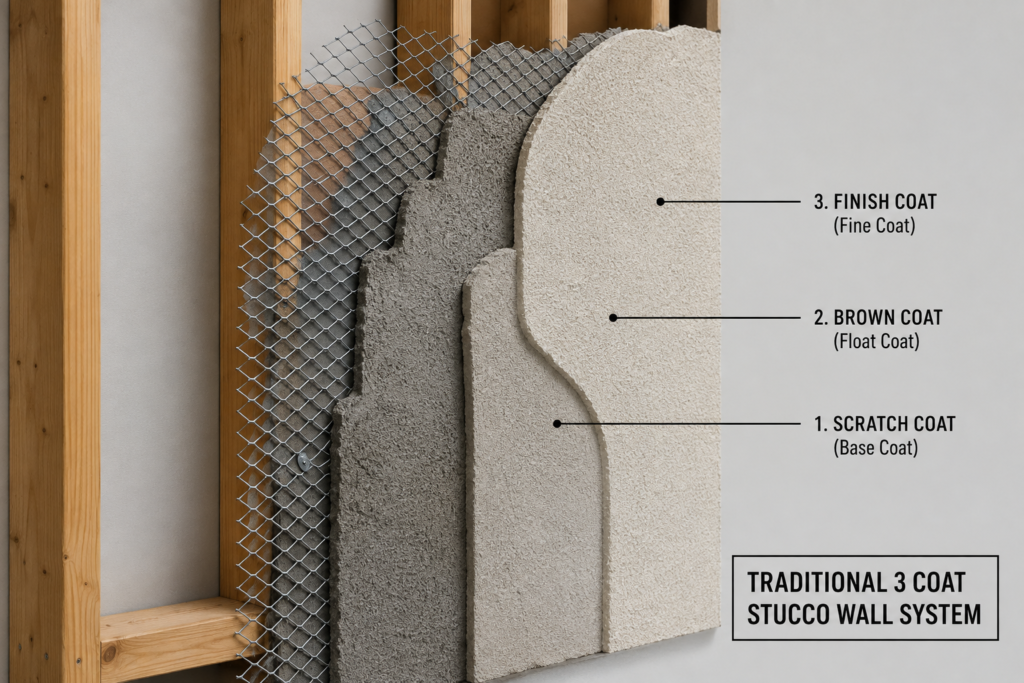
When contractors talk about traditional stucco installation, the 3 coat stucco system is the gold standard. It includes three distinct layers applied over a substrate:
- Scratch coat — the base layer, applied over wire lath and mechanically bonded to it
- Brown coat — the leveling layer that builds out thickness and provides structural rigidity
- Finish coat — the final exterior surface that receives texture and, optionally, integral color
Each coat contributes to the total thickness of the stucco assembly. A properly completed 3 coat system typically reaches 7/8 inch total thickness. That thickness is meaningful in a fire scenario — not just aesthetically.
Thicker stucco means more mass between the exterior flame and the interior of the wall. The cementitious material absorbs and deflects radiant heat, slowing the rate at which temperatures rise inside the wall cavity. That delay can be the difference between a fire that self-extinguishes and one that finds structural framing to consume.
Fire research on exterior wall assemblies consistently demonstrates that the density and thermal mass of cementitious coatings extend the time before structural compromise. In wildfire testing by building science laboratories, stucco-clad homes perform markedly better than vinyl siding, wood shingles, and even certain fiber cement products.
EIFS vs. Traditional Stucco: Fire Resistance Compared
Not all stucco systems are created equal when it comes to fire performance. EIFS — Exterior Insulation and Finish Systems — looks nearly identical to traditional stucco from the outside, but the underlying assembly is structurally different.
EIFS consists of:
- An adhesive or mechanical attachment method
- A rigid foam insulation board (typically EPS — expanded polystyrene)
- A reinforced base coat embedded with fiberglass mesh
- A finish coat
The foam insulation board at the core of an EIFS system is the variable that changes the fire conversation entirely. EPS foam is combustible. It will burn under sustained flame exposure, and in some configurations, it can contribute fuel to a fire if the protective layers are compromised.
Here’s a practical comparison:
| Feature | Traditional Stucco (3 Coat) | EIFS |
|---|---|---|
| Base Material | Portland cement, sand, water | EPS foam board + cementitious coatings |
| Combustibility | Non-combustible | Foam layer is combustible |
| Fire Rating Potential | Up to 2-hour assembly rating | Dependent on foam type and assembly |
| Drainage | No drainage plane | Vertical drainage plane |
| Finish Options | Multiple textures and integral color | Multiple textures and integral color |
| Application Surface | Wire lath with fiber mesh overlay | Foam board with fiberglass mesh |
One important distinction: EIFS systems do include a vertical drainage plane, while traditional stucco does not have a drainage plane. That’s a functional difference in how the two systems manage moisture — but in a fire scenario, the drainage plane gap also affects how air and heat move behind the cladding.
This doesn’t mean EIFS is inferior overall. It means you need to understand the specific system you have and how it was installed. Manufacturers of EIFS products have worked extensively to improve fire performance, and many modern EIFS assemblies carry tested fire ratings. But the baseline fire resistance of traditional 3 coat stucco — with its solid, all-mineral construction — is inherently more straightforward.
What About Stucco Cracks and Fire Safety?
Stucco that is cracked, spalled, or compromised is a different story. When the cementitious layer develops gaps, those gaps can allow fire, embers, or superheated gases to reach what’s behind the stucco — which in most residential construction is wood framing, paper-faced housewrap, or foam.
This is why maintenance isn’t just an aesthetic concern. It’s a performance concern.
When stucco repairs are performed correctly, the process involves crack chasing — grinding or routing the crack to create a clean, defined channel — followed by application of a compatible sealant, then finishing with stucco matching to restore the original texture and color. Done properly, this restores the wall to its original continuous surface, closing off any vulnerability.
Patched stucco that matches the surrounding surface isn’t just visually cohesive. It’s structurally and functionally restored.
If you live in Southwest Florida and your home shows signs of cracking, don’t treat it as a cosmetic problem alone. Stucco cracks allow moisture intrusion, compromise structural integrity, and reduce the continuity of the fire-resistant barrier your wall system is supposed to provide.
Does Stucco Meet Building Code Fire Requirements?
In most U.S. jurisdictions, including throughout Florida, exterior cladding must meet specific fire-resistance classifications under the International Building Code and its adopted state equivalents. Stucco regularly satisfies these requirements, which is a key reason it remains so prevalent in residential and commercial construction.
Florida’s building code is particularly rigorous — partly because of hurricane exposure, but also because of the fire risk posed in certain counties and during dry seasons. Stucco’s combination of non-combustibility, impact resistance, and longevity makes it a code-compliant choice that performs across multiple risk categories simultaneously.
For commercial construction in particular, tested and listed wall assemblies using stucco are commonly used to achieve required fire separation between tenant spaces or between a structure and a property line. These assemblies are third-party tested, and their ratings apply to the entire system — not just the stucco layer.
Stucco Finish Types and Their Role in Fire Resistance
The finish coat — what you actually see on the surface — doesn’t dramatically change the fire resistance profile of the underlying system. However, it’s worth understanding what your options are and how they relate to overall wall performance.
Smooth finish stucco is applied with a steel trowel, creating a dense, refined surface with minimal texture variation. The steel troweling process compresses the finish layer, resulting in a surface with fewer micro-pores and less surface area for airborne embers to land and catch.
Float finish and sand finish textures create a slightly more open surface. These are the most common textures in Florida residential construction and are equally effective in standard fire scenarios.
Both smooth and float finishes are compatible with integral color — pigment mixed directly into the finish coat rather than applied as a paint layer on top. Integral color maintains the full thickness and integrity of the finish coat, which matters when you’re thinking about long-term surface continuity and durability.
“A stucco wall is one of the very few exterior assemblies where the cladding material itself contributes meaningfully to fire resistance — not just fire aesthetics.”
Paint-only color systems create a separate layer that can eventually peel or degrade. Integral color becomes part of the stucco itself, meaning your finish is durable, resistant to UV fade, and maintains its visual uniformity through weathering.
Stucco in Southwest Florida: Fire Risk Context
Southwest Florida — including the Fort Myers, Naples, and Cape Coral areas — isn’t typically associated with the wildfire risk of California or Colorado. But that doesn’t mean fire is irrelevant here.
Dry season brush fires are a real occurrence in Lee and Collier Counties. Electrical fires, construction fires, and accidental structure fires happen across all regions. And with the density of residential development in Southwest Florida, fire spread between adjacent structures is always a consideration.
For homeowners here, stucco’s fire resistance is one of several reasons it’s the dominant exterior cladding. The climate compatibility is obvious. But the code compliance, the longevity, the low maintenance compared to wood siding, and the passive fire protection all compound to make stucco the sensible default choice.
When your stucco is installed correctly — with a proper 3 coat stucco system over wire lath, with appropriate fiber mesh reinforcement, and with a finish coat suited to the application — you have an exterior wall that handles heat, wind, rain, and incidental fire exposure without compromise.
When to Prioritize Stucco Inspection After Fire Exposure
If your home has experienced any fire exposure — even indirect heat from a nearby structure fire, a brush fire, or a significant garage fire that vented through exterior walls — get the stucco inspected before assuming it’s intact.
Heat exposure that doesn’t visibly damage stucco can still alter the bond between coats or between the scratch coat and the wire lath. In severe cases, the cement can calcify and lose structural integrity even without visible cracking. A qualified stucco contractor can identify these issues through physical inspection and targeted probing.
Repairs after fire exposure follow the same fundamental process as standard crack repair — crack chasing, sealant application, and stucco matching — but may also involve full section removal if the underlying assembly is compromised.
Conclusion
Stucco is genuinely fire resistant. That’s not marketing language — it’s material science. The Portland cement, sand, and aggregate that make up a properly installed stucco system are non-combustible by nature, and the mass and thickness of a complete 3 coat application actively slows fire spread.
EIFS performs differently because of its foam insulation core, and that difference matters if you’re comparing systems or selecting a cladding for new construction.
For homeowners across Southwest Florida, the practical takeaway is straightforward: stucco is one of the best exterior cladding choices for passive fire resistance, especially when it’s properly installed and regularly maintained. Cracks aren’t just cosmetic — they’re interruptions in a protective layer that does real work. Keep the stucco intact, and it keeps working for you.
If your home’s exterior stucco needs repair, inspection, or full installation, Cousins Stucco serves homeowners and businesses throughout Fort Myers, Naples, Cape Coral, and the surrounding communities across Lee and Collier Counties. Reach out to get the job assessed by a team that understands the material from the ground coat up.
Frequently Asked Questions
Is stucco considered a fire-resistant material?
Yes. Traditional stucco made from Portland cement, sand, and water is non-combustible. It does not ignite, does not contribute fuel to a fire, and can contribute to a tested fire-resistance rating when part of a properly constructed wall assembly.
How long can stucco resist fire?
The fire resistance duration depends on the full wall assembly — not just the stucco layer alone. A properly constructed stucco wall system can achieve ratings of one to two hours under standardized fire testing conditions.
Does EIFS have the same fire resistance as traditional stucco?
No. EIFS uses an expanded polystyrene foam insulation board as part of its assembly, and EPS foam is combustible. While EIFS manufacturers produce systems with tested fire ratings, traditional 3 coat stucco with its all-mineral composition offers more inherent fire resistance at the material level.
Can stucco cracks compromise fire resistance?
Yes. Cracks break the continuity of the protective layer and can allow fire, embers, or superheated gases to reach combustible materials behind the stucco. Prompt crack repair using proper crack chasing, sealant, and stucco matching restores the wall’s intended performance.
Is stucco a good choice for fire-prone areas?
Stucco is widely regarded as one of the most fire-resistant exterior cladding options available for residential and commercial construction. Its non-combustible composition, thermal mass, and code-compliant performance make it a smart choice for any region where fire risk is a factor.