
EIFS stucco has become one of the most debated exterior wall systems in the construction industry — and for good reason. Homeowners, builders, and contractors across Southwest Florida often confuse it with traditional stucco, assume it performs the same way, or overlook it entirely when exploring exterior finish options. That’s a mistake worth correcting.
Whether you’re building new, renovating, or trying to diagnose a problem with your current exterior, understanding EIFS gives you a genuine advantage. This guide breaks down exactly what EIFS is, how it differs from traditional stucco, and what you need to know before making any decisions about installation or repair.
What Is EIFS Stucco?
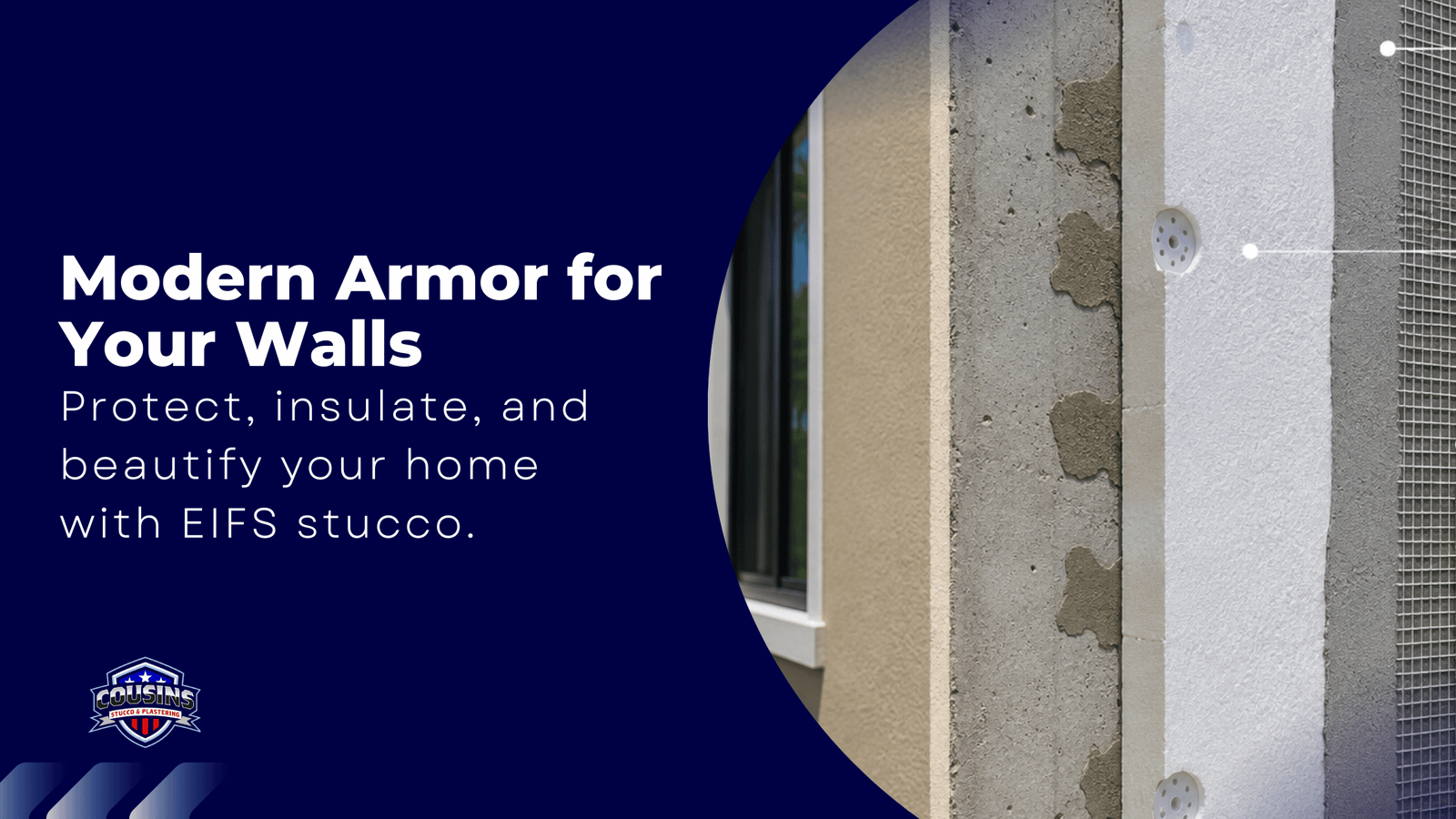
EIFS stands for Exterior Insulation and Finish System. It’s a multi-layered cladding system that combines rigid foam insulation with a reinforced base coat and a textured finish coat — all applied to the exterior of a building. The result is a wall system that provides both an aesthetic finish and a thermal barrier in a single integrated assembly.
Despite being commonly called “EIFS stucco,” it’s technically distinct from traditional three-coat stucco. The term “stucco” gets attached because the finish layer looks similar and is applied with comparable techniques. But structurally, the two systems operate on completely different principles.
EIFS was introduced to the United States in the 1960s and gained serious traction through the 1980s and 1990s as energy efficiency became a growing priority. It’s widely used on both commercial and residential buildings and is especially relevant in climates like Southwest Florida, where thermal performance and moisture management directly affect long-term durability.
How EIFS Is Structured
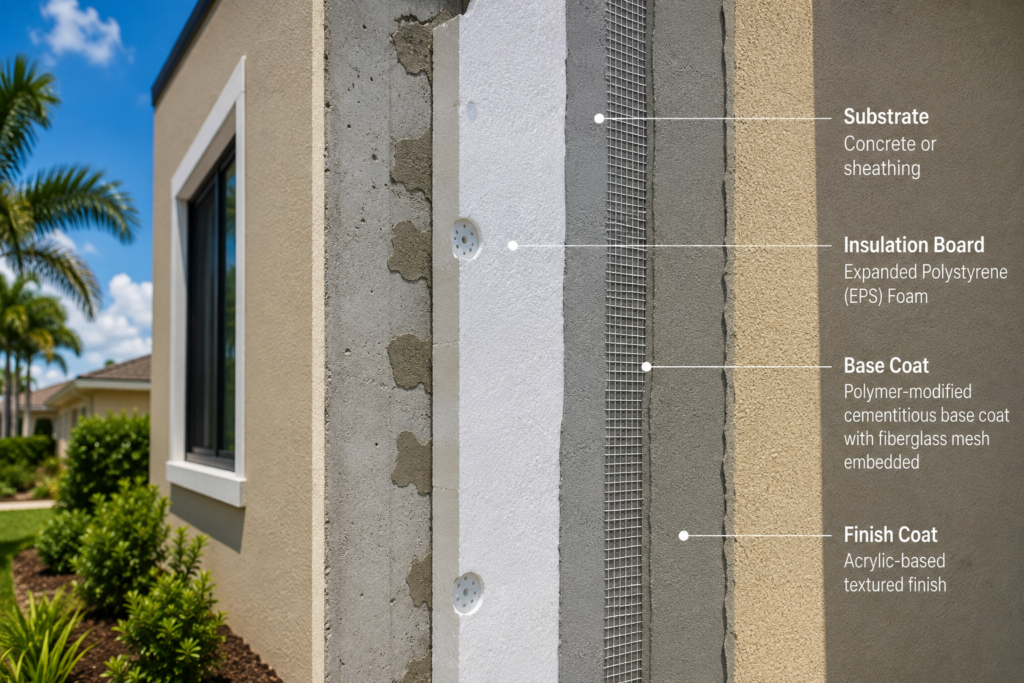
The system is built from the outside in, with each layer playing a defined role:
- Substrate — The base wall, typically wood sheathing, concrete block, or steel framing
- Drainage plane — A critical component that allows any moisture that enters the system to escape vertically rather than becoming trapped
- Adhesive or mechanical fasteners — Used to attach the insulation board to the substrate
- Rigid foam insulation board — Usually expanded polystyrene (EPS), available in varying thicknesses
- Base coat — A polymer-modified cement applied over the insulation
- Fiberglass mesh — Embedded into the base coat for reinforcement and crack resistance
- Finish coat — The outermost textured layer that gives EIFS its visual character
One architectural detail that sets EIFS apart is its vertical drainage plane. Unlike traditional stucco, which bonds directly to the substrate without a drainage layer, EIFS systems include a built-in pathway for water to move down and out. This is a critical performance difference that affects moisture management, especially in humid coastal environments.
EIFS vs. Traditional Stucco: Key Differences
These two systems share a similar appearance but diverge significantly in their construction, performance characteristics, and ideal applications.
| Feature | EIFS | Traditional Stucco |
|---|---|---|
| Drainage Plane | Vertical drainage plane included | No drainage plane |
| Insulation | Built-in rigid foam layer | None inherent to system |
| Weight | Lightweight | Heavier |
| Flexibility | More impact-resistant outer layer | More rigid and more prone to cracking |
| Application Base | Foam insulation board | Wire lath with fiber mesh over lath |
| Moisture Management | Engineered drainage pathway | Relies on surface and flashing |
| Energy Performance | Higher thermal resistance | Lower thermal resistance |
Traditional stucco is applied over wire lath, and fiber mesh is used specifically in that context — over the lath — to reinforce the scratch coat. EIFS uses fiberglass mesh embedded into its base coat layer, which serves a different structural function within that system. Confusing the two can lead to mismatched repair approaches and long-term problems.
Why EIFS Makes Sense in Southwest Florida
Florida’s climate creates a specific set of demands for any exterior wall system. Heat, humidity, salt air near the coast, and the occasional severe weather event all stress your building envelope in ways that colder, drier climates simply don’t.
EIFS performs well in this environment for several reasons. The foam insulation layer reduces thermal bridging, helping keep conditioned air inside longer and lowering energy consumption. In a region where air conditioning runs most of the year, that matters.
The drainage plane component is particularly valuable along the Gulf Coast. Coastal areas like Naples, Fort Myers Beach, and Bonita Springs see significant moisture intrusion risk from driving rain and high ambient humidity. A system with a properly engineered drainage pathway handles that moisture more effectively than one without.
EIFS also offers design flexibility. The finish coat can be applied in a wide range of textures — from smooth to heavily textured — and can replicate the look of traditional stucco, limestone, or other architectural finishes. That matters when you’re trying to match or complement surrounding structures.
Common EIFS Problems and What Causes Them
EIFS performs well when installed correctly. When it doesn’t, the problems are usually traceable to installation errors, inadequate detailing at penetrations, or deferred maintenance.
Impact damage is one of the most frequent issues. The finish coat of EIFS is not hard like traditional stucco. It can dent, crack, or puncture from lawn equipment, sports equipment, or impacts during storms. Small damage areas should be addressed promptly before moisture finds its way into the system.
Cracks at joints or around windows and doors are another common complaint. These often develop when the system wasn’t properly detailed at transitions, when sealant wasn’t maintained, or when the building has experienced settlement. The concern isn’t aesthetic — it’s functional. Cracks create pathways for water infiltration.
Delamination occurs when the foam insulation board or base coat separates from the substrate. This can happen due to moisture infiltration behind the system, improper adhesive application, or mechanical fastener failure. If you tap on the wall and hear a hollow sound in areas where it shouldn’t be hollow, that’s a warning sign worth investigating.
Sealant failure around windows, doors, and penetrations is arguably the most common starting point for moisture-related EIFS problems. Sealant degrades over time and needs periodic inspection and replacement. This is especially true in Florida’s UV-intense environment, which accelerates degradation.
If you’re seeing any of these issues on your property, the right response isn’t to ignore them or cover them up. Getting stucco repair from a contractor who understands EIFS-specific repair methods is essential.
How EIFS Repair Works
Repairing EIFS is not the same as repairing traditional stucco, and contractors who treat it that way often make problems worse. Each layer of the system needs to be addressed in the right sequence, and material compatibility is critical.
For surface cracks, the process involves crack chasing to open and clean the crack, followed by application of appropriate sealant, then stucco matching to restore the surface appearance. The goal is both to seal the damage and to make the repaired area visually consistent with the surrounding finish. You can learn more about the proper approach to stucco crack repair and why doing it right the first time matters.
For deeper damage involving the base coat or foam insulation board, the repair process becomes more involved. The damaged section typically needs to be cut out, the foam replaced if compromised, new base coat applied with embedded mesh, and finish coat matched to the surrounding texture and color.
Texture matching in EIFS repairs requires skill. The finish coat has to be applied at the right consistency, with the right tool motion, to replicate the existing pattern. A poorly matched repair can be visually obvious for years. Working with a contractor who specializes in stucco texture matching ensures a result you won’t be looking at apologetically every time you pull into your driveway.
EIFS Installation: What the Process Looks Like
If you’re considering EIFS for a new build or as part of a major renovation, understanding the installation sequence helps you evaluate proposals and verify work quality.
The process begins with preparing the substrate — making sure it’s flat, structurally sound, and properly detailed at all penetrations, transitions, and terminations. This prep work is where most future problems are either prevented or created.
Insulation boards are then applied to the substrate using adhesive, mechanical fasteners, or a combination depending on the substrate type and project specifications. Boards are staggered at joints to prevent continuous vertical seams.
The base coat is applied over the insulation boards, and fiberglass mesh is immediately embedded into the wet base coat, overlapping seams by a minimum of several inches. Additional mesh is used at corners and stress points. This mesh layer is what gives EIFS its crack resistance and structural continuity across the foam surface.
Once the base coat cures, the finish coat is applied. This is the layer you see. Vinyl accessories — including corner bead, control joints, and expansion joints — are installed at appropriate intervals and transitions to allow for movement and define clean lines. These vinyl accessories are the standard in properly executed EIFS installations.
The entire system is sealed at all penetrations, transitions, windows, doors, and terminations. This detailing step is where the system’s long-term moisture performance is either secured or compromised.
EIFS and Commercial Buildings
EIFS has deep roots in commercial construction. Walk through almost any commercial district in Naples, Fort Myers, or Cape Coral and you’ll see EIFS on retail buildings, office complexes, medical facilities, and institutional structures. It’s popular in commercial applications for several reasons.
Design flexibility tops the list. Architects can achieve a wide range of visual profiles — smooth surfaces, textured finishes, simulated stone, complex reveals, and architectural shapes — all within a single integrated system. The foam insulation board can be carved or shaped before the base coat is applied, allowing for decorative elements that would be expensive or impractical with other systems.
Weight is another factor. Traditional masonry or stone veneer adds significant structural load. EIFS is comparatively lightweight, which can simplify structural requirements and reduce overall construction cost.
Energy code compliance is increasingly relevant as Florida’s building codes evolve. EIFS’s continuous insulation layer helps commercial buildings meet thermal performance standards that other cladding systems struggle to achieve without added complexity.
Maintenance on commercial EIFS should be part of every building management plan. Regular inspection of sealants, monitoring for impact damage, and prompt repair of any breaches in the system prevents small issues from becoming significant and disruptive restoration projects.
Choosing the Right Contractor for EIFS Work
Not every stucco contractor understands EIFS. The two systems require different knowledge, different materials, and different techniques. Hiring someone who works primarily in traditional stucco to handle an EIFS project — especially a repair — is a gamble that rarely pays off.
You want a contractor who can clearly explain the difference between the two systems, who understands the drainage plane concept and why it matters, and who can articulate how they’ll approach matching your existing finish. Ask to see examples of previous EIFS work, particularly repairs, where texture and color matching is most evident.
Material selection matters too. Vinyl accessories are the appropriate choice for EIFS work — they provide the flexibility, compatibility, and longevity the system requires. Corner bead, control joints, and termination bars should all be vinyl to maintain the system’s performance characteristics over time.
If you’re in Naples, Fort Myers, Cape Coral, or anywhere else across Southwest Florida and you have questions about your current exterior or a project you’re planning, contact Cousins Stucco directly to discuss what makes sense for your specific situation.
Maintaining Your EIFS Exterior
Maintenance is where most EIFS problems begin — not during installation, but in the years after, when sealants age, small impacts go unaddressed, and inspections don’t happen. A few proactive habits significantly extend the life of the system.
- Inspect sealant at all windows, doors, and penetrations annually
- Address any impact damage, cracks, or holes immediately rather than deferring
- Keep landscaping and irrigation heads from directing water against the EIFS surface
- Avoid pressure washing with high pressure, which can damage the finish coat
- Look for staining patterns on the surface, which can indicate moisture pathways
EIFS that’s well maintained can perform reliably for decades. The system earns its reputation not from neglect tolerance, but from proper initial installation and consistent upkeep.
Frequently Asked Questions About EIFS Stucco
What is the main difference between EIFS and traditional stucco?
The most significant structural difference is the drainage plane. EIFS includes a vertical drainage plane that allows moisture to exit the system. Traditional stucco has no drainage plane and relies on surface management and flashing to handle water. EIFS also incorporates a layer of rigid foam insulation that traditional stucco doesn’t include, which affects both thermal performance and the overall weight of the wall assembly.
Can EIFS be repaired if it gets damaged?
Yes. EIFS can be repaired effectively when the work is done by someone who understands the system. Surface cracks are addressed through crack chasing, sealant application, and stucco matching. Deeper damage involving the base coat or foam board requires removal of the compromised section, substrate inspection, foam replacement if needed, and full base and finish coat restoration with proper texture matching.
Is EIFS a good choice for Florida homes?
EIFS can be a strong choice for Florida homes, particularly because of its built-in insulation layer and drainage plane. In a climate defined by heat, humidity, and coastal moisture, having a system engineered to manage thermal performance and provide a moisture exit pathway has real advantages. Proper installation and ongoing maintenance are non-negotiable factors in how well the system performs long-term.
How long does EIFS last?
When installed correctly and maintained appropriately, EIFS can last 25 years or more. The limiting factors are usually sealant degradation at penetrations and transitions, impact damage that goes unrepaired, and deferred maintenance. Regular inspection and prompt attention to any issues identified extend the system’s service life considerably.
Does EIFS require special maintenance compared to regular stucco?
The maintenance requirements are similar in some ways — both need periodic inspection and repair of cracks or surface damage. EIFS has one additional maintenance priority: sealant joints at all system terminations, windows, and penetrations need regular inspection and replacement as they age. Because the foam insulation layer is vulnerable to prolonged moisture exposure if sealant fails, staying current on sealant maintenance is especially important with EIFS.