
Managing a multi-family community or a commercial plaza in Southwest Florida is a high-stakes balancing act. Between stringent insurance requirements and the relentless Gulf Coast elements, the building envelope is under constant attack. For board members and property managers, understanding the nuances of commercial stucco maintenance swfl protocols is essential for long-term fiscal health and structural safety.
In this environment, stucco isn’t just a decorative finish—it is a structural shield. When maintained correctly, it lasts decades; when neglected, it becomes a liability that leads to massive special assessments. This guide serves as a pillar for preserving large-scale properties through effective exterior care.
The Fiduciary Duty of HOA Stucco Repair
For HOA boards, staying on top of HOA stucco repair is a fiduciary responsibility. Deteriorating exteriors don’t just hurt curb appeal; they signal to insurance carriers that a property is a high risk for moisture intrusion and structural failure. In the current Florida market, this can lead to skyrocketed premiums or even non-renewal.
Professional contractors recommend a proactive “Cycle of Care” rather than waiting for a resident to report a leak. By the time water is visible on the interior drywall of a condo unit, the internal damage to the lath matrix past the structural termination line has often been progressing for years.
The Professional Stucco Maintenance SWFL Process for Large-Scale Properties
When a commercial property requires remediation, the installation and repair process differs significantly from residential patching. It requires coordination, safety scaffolding, and a deep understanding of large-scale expansion joints.
- Waterproof Barrier Integrity: On large buildings, we ensure the drainage plane transitions cleanly past the casing bead across floor lines to prevent systemic failure.
- Structural Lathing: We use heavy-duty, corrosion-proof lath matrix solutions to handle the wind-load requirements of coastal Florida building codes, excluding all metal or zinc options.
- Expansion Joint Management: Large walls expand and contract significantly in the Florida sun. If these joints aren’t maintained with durable vinyl accessories, the stucco will inevitably buckle and crack.
Why Experience Matters: Choosing the Right Partners
Large-scale projects require more than just a crew; they require project management. A team specializing in commercial stucco maintenance must navigate the complexities of working around residents, protecting common area landscaping, and adhering to strict OSHA safety standards.
At Cousins Stucco, we specialize in helping HOAs and commercial owners avoid the “patch and pray” cycle. We offer transparent pricing, typically ranging from $15 to $30 per linear foot for targeted remediation. This allows boards to budget for phased repairs rather than hit homeowners with sudden, massive costs.
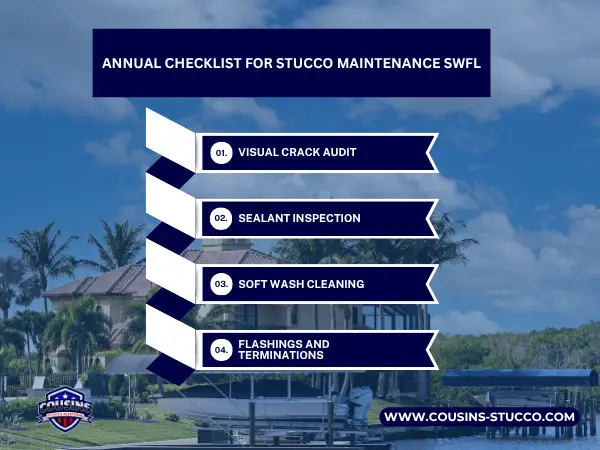
Annual Checklist for Stucco Maintenance SWFL
To extend the life of your stucco and satisfy insurance requirements, implement this annual checklist for stucco maintenance swfl:
- Visual Crack Audit: Inspect “stair-step” patterns near second and third-story windows where stress is highest.
- Sealant Inspection: Check the caulking around all commercial window units and vinyl control joints for drying or peeling.
- Soft Wash Cleaning: Remove salt spray and organic growth (mold/mildew) that can eat away at the protective elastomeric paint layer.
- Flashings and Terminations: Examine the metal and vinyl diverters above rooflines, doors, and balconies to ensure water flows away from the walls.
The Long-Term ROI of Proactive Repair
A well-maintained stucco system can last 50 years or more. However, in Southwest Florida, the “sealant” (paint and caulk) only lasts about 8 to 10 years. By staying ahead of HOA stucco repair needs, you stabilize property values and ensure that your reserve funds aren’t drained by emergency structural repairs.
Frequently Asked Questions
How often should an HOA perform a professional stucco inspection?
We recommend a professional visual inspection every 2 years and a full moisture scan every 5 years. This documented history is invaluable for insurance renewals and real estate disclosures.
Does “patching” stucco look bad on large commercial buildings?
Not if done by experts. We specialize in advanced texture matching to ensure repaired areas blend into the original wall. Please note that while we provide expert patching and texture replication, standalone painting services are not offered unless they are part of a full EIFS system installation or repair.
Why is linear foot pricing better for HOAs?
Square foot pricing often leads to overpaying for “undamaged” areas. Linear foot pricing allows boards to pay only for the specific cracks or failures addressed, maximizing the ROI of the maintenance budget. However, if it’s a bigger damage, Specialists give estimates in Square foot.
Can we repair commercial stucco during the rainy season?
Yes, but it requires careful scheduling. For large projects, we utilize weather-tracking and protective shielding to ensure the curing process isn’t interrupted by afternoon storms.
What is the most common cause of HOA stucco failure?
Improperly sealed expansion joints and window perimeters. On large buildings, these are the primary entry points for wind-driven rain during tropical systems if the bottom termination lines are not kept clear.
Is your HOA board preparing for the next maintenance cycle? Don’t wait for a leak to become a lawsuit or a massive assessment. Contact Cousins Stucco today for a comprehensive property walk-through. We provide detailed, professional estimates using vinyl-only trims and beads that help HOAs and commercial owners protect their investments with confidence.