Common EIFS Problems in Fort Myers Homes: What Every Homeowner Should Know
Exterior Insulation and Finish Systems (EIFS) have become a popular exterior wall system throughout Fort Myers and Southwest Florida because they provide excellent design flexibility, energy efficiency, and a durable exterior finish. Like any exterior wall system, however, EIFS performs best when it is properly installed, maintained, and repaired when necessary.
Southwest Florida’s combination of high humidity, heavy seasonal rainfall, hurricane-force winds, and intense UV exposure places continuous stress on exterior wall assemblies. While modern EIFS systems are designed to help manage incidental moisture through a vertical drainage plane, neglected maintenance or damaged components can allow moisture to reach areas that require professional attention.
Understanding the most common EIFS issues can help homeowners identify concerns early and make informed decisions before repairs become more extensive.
Key Takeaways
- EIFS (Exterior Insulation and Finish Systems) is highly vulnerable to moisture intrusion, especially in Fort Myers’ humid, rain-heavy climate.
- Most EIFS failures trace back to installation errors, not the material itself.
- Water trapped behind EIFS cladding can cause wood rot, mold, and structural damage within months.
- Annual professional inspections are strongly recommended for any Fort Myers home with EIFS cladding.
- Barrier EIFS (no drainage plane) carries significantly higher risk than drainage-type EIFS systems in Florida conditions.
- Early detection through moisture testing or infrared scanning can prevent full-system replacement costs.
Why Southwest Florida’s Climate Creates Unique Challenges
Fort Myers experiences environmental conditions unlike many other parts of the country.
Throughout the year, exterior walls are exposed to:
- Intense UV radiation
- High humidity
- Heavy seasonal rainfall
- Wind-driven rain during tropical storms
- Daily expansion and contraction from temperature changes
These conditions continually stress exterior finishes, sealants, and transition points around the building.
When an EIFS system is properly installed, its vertical drainage plane helps manage incidental moisture within the wall assembly. However, if moisture enters through deteriorated sealants, damaged finishes, or improperly maintained transitions, the wall system should be evaluated to determine whether repairs are needed.
Routine inspections and timely repairs help preserve both the appearance and performance of the exterior system.
Common EIFS Problems Homeowners Should Watch For
1. Cracks Around Windows, Doors, and Wall Penetrations
One of the most common concerns involves cracking near windows, doors, utility penetrations, and other wall transitions.
These areas naturally experience more movement than large wall surfaces due to differences in materials and daily expansion and contraction.
Small cracks may begin as cosmetic concerns, but they should be monitored because they can allow moisture to reach areas behind the exterior finish.
Rather than focusing solely on the visible crack, a professional evaluation considers the surrounding weather-resistive barrier integration, sealants, and overall condition of the wall assembly.
2. Deteriorated Sealants
Sealants around windows, doors, expansion joints, and other transitions naturally age over time.
Southwest Florida’s UV exposure and high temperatures gradually reduce their flexibility, allowing small openings to develop.
As sealants deteriorate, moisture management around these transitions becomes less effective.
Routine inspection and replacement of deteriorated sealants are an important part of maintaining both EIFS and traditional stucco systems.
3. Impact Damage
EIFS finishes are durable, but impacts from landscaping equipment, storm debris, or accidental contact can damage the exterior finish.
Even localized damage should be repaired promptly to restore the integrity and appearance of the wall system.
Depending on the extent of the damage, repairs may include rebuilding the affected area using compatible EIFS materials while matching the existing texture and finish.
4. Surface Cracking
Not every crack indicates a major problem.
Hairline cracks may develop from normal building movement, curing, or thermal expansion.
However, cracks that continue to widen, appear in multiple locations, or are accompanied by loose or hollow-sounding areas should be professionally evaluated.
The location, pattern, and condition of the crack are often more important than its width alone.
How Moisture Can Affect EIFS
Like any exterior wall system, EIFS relies on proper installation and ongoing maintenance.
Modern drainage EIFS systems include a vertical drainage plane designed to help manage incidental moisture within the wall assembly.
If moisture enters the system through damaged sealants, impact damage, or deteriorated exterior finishes, it should be evaluated before additional deterioration occurs.
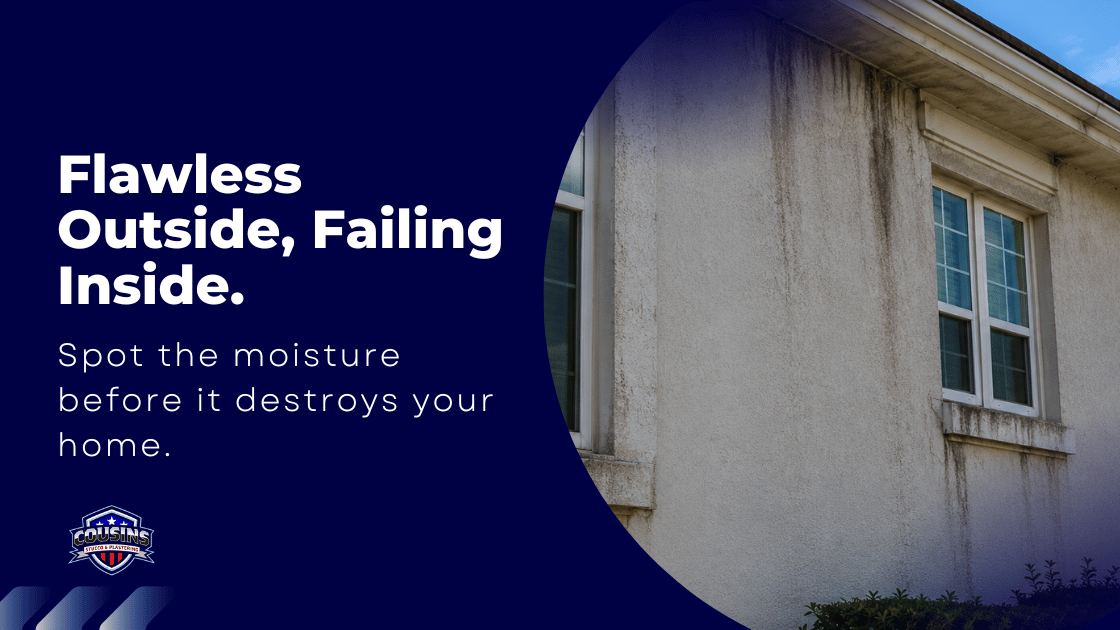
Possible signs that moisture may be affecting the system include:
| Observation | Possible Condition |
| Localized staining | Moisture should be evaluated |
| Expanding cracks | Building movement or deterioration may be occurring |
| Loose or hollow-sounding finish | Localized separation may have developed |
| Repeated repairs in the same area | Further evaluation may be recommended |
| Changes following a major storm | Inspection may help identify hidden damage |
Because every building is different, determining the cause requires evaluating the entire wall assembly rather than relying on one visible symptom.
Signs Your EIFS Should Be Evaluated
Homeowners should consider scheduling a professional evaluation if they notice:
- New or expanding cracks
- Loose or hollow-sounding areas
- Localized staining
- Visible impact damage
- Deteriorated sealants
- Changes following a hurricane or severe storm
A professional inspection helps determine the condition of the existing EIFS system and whether localized repairs or more extensive restoration are appropriate.
Proper Installation Matters More Than the Material
Many EIFS problems are not caused by the system itself, but by improper installation or deferred maintenance. A properly installed EIFS system is designed to perform well in Southwest Florida’s climate when installed according to manufacturer specifications and maintained over time.
Several installation details contribute to the long-term performance of the wall assembly.
Proper Base Preparation
Every successful EIFS installation starts with a properly prepared substrate.
For framed wall assemblies, compatible sheathing, water-resistive barriers, and drainage components work together to create the foundation for the EIFS system. Each layer must be installed according to manufacturer requirements before insulation boards, reinforcing mesh, base coat, and finish coat are applied.
Taking shortcuts during preparation can affect the long-term performance of the exterior system.
Proper Drainage Design
Modern EIFS systems incorporate a vertical drainage plane that helps manage incidental moisture within the wall assembly.
Rather than trapping moisture, drainage EIFS systems are designed to direct incidental water downward through the drainage cavity where it can exit at the appropriate termination point.
This design helps reduce the likelihood of moisture remaining within the wall assembly while allowing the system to perform as intended.
Routine maintenance of sealants and exterior transitions remains important to support long-term performance.
Compatible Accessories
Quality accessories play an important role in both performance and appearance.
Depending on the project, EIFS installations may incorporate compatible vinyl accessories such as:
- Vinyl casing beads
- Control joints
- Expansion joints
- Termination beads
- Architectural reveals
These accessories help create clean transitions throughout the wall system while accommodating normal building movement.
Because Southwest Florida’s coastal environment exposes exterior materials to humidity and salt air, compatible vinyl accessories provide excellent long-term durability.
EIFS Over Framed Construction
EIFS is commonly installed over framed wall assemblies.
Depending on the wall design and manufacturer specifications, the assembly may include:
- DensGlass sheathing
- Water-resistive barrier
- Vertical drainage plane
- EIFS insulation board
- Reinforcing mesh embedded in the base coat
- Finish coat
Each layer performs a specific function, and the complete system is designed to work together rather than as individual components.
EIFS and Concrete Masonry (CMU)
Concrete masonry buildings require a different approach than framed construction.
EIFS is not installed directly over CMU block.
Instead, a traditional stucco system is first applied to establish a suitable substrate before the EIFS finish system is installed. This approach provides a stable base while maintaining compatibility with the EIFS assembly.
Selecting the appropriate wall assembly depends on the building design, substrate, and manufacturer requirements.
Common Maintenance Mistakes
Many exterior issues develop because small maintenance items are postponed.
Common examples include:
- Delaying replacement of deteriorated sealants
- Ignoring impact damage
- Leaving cracks unaddressed
- Waiting until visible staining becomes widespread
- Skipping inspections after severe storms
Addressing these concerns early often allows localized repairs before larger sections require restoration.
Barrier EIFS vs. Drainage EIFS
Earlier EIFS systems were commonly installed as barrier systems, relying primarily on the exterior finish to resist moisture.
Modern drainage EIFS systems incorporate a vertical drainage plane that helps manage incidental moisture that reaches the wall assembly.
Today’s drainage EIFS designs provide improved moisture management while maintaining the energy efficiency and design flexibility that EIFS is known for.
Proper installation and ongoing maintenance remain essential regardless of the system type.
Why Routine Maintenance Matters
Like roofing, windows, and sealants, EIFS benefits from routine inspections.
Periodic evaluations help identify:
- Aging sealants
- Surface cracks
- Impact damage
- Localized staining
- Areas that may benefit from maintenance
Addressing these items before they become more extensive helps preserve both the appearance and long-term performance of the wall system.
Frequently Asked Questions
What are the most common EIFS problems in Fort Myers?
Some of the most common EIFS concerns include surface cracking, deteriorated sealants, localized impact damage, moisture-related staining, and changes that become visible after severe storms. Regular maintenance and prompt repairs help maintain the long-term performance of the system.
How is EIFS different from traditional stucco?
Traditional stucco is a cement-based exterior finish, while EIFS is a multi-layer exterior wall system that incorporates insulation, reinforcing mesh, a base coat, finish coat, and—on modern drainage systems—a vertical drainage plane that helps manage incidental moisture. Each system has different installation methods and should be repaired using materials compatible with the existing wall assembly.
Can hurricanes damage EIFS?
Yes. Southwest Florida hurricanes expose exterior wall systems to wind-driven rain, flying debris, and significant pressure changes. After a major storm, it is a good idea to inspect the exterior for impact damage, deteriorated sealants, new cracks, or other visible changes that may require professional evaluation.
Does every EIFS crack require repair?
Not necessarily. Some hairline cracks may result from normal curing or thermal movement, while larger cracks, expanding cracks, or cracks accompanied by staining or loose material should be professionally evaluated to determine the appropriate repair method.
What accessories are used with EIFS?
Depending on the project, EIFS installations may incorporate compatible vinyl accessories including:
Vinyl casing beads
Control joints
Expansion joints
Termination beads
Architectural reveals
These components help create clean transitions throughout the wall system while accommodating normal building movement.
Can EIFS be installed directly over concrete block?
No. For concrete masonry unit (CMU) construction, a traditional stucco system is first installed to establish a suitable substrate before the EIFS finish system is applied. The installation method depends on the building design and manufacturer requirements.
How often should EIFS be inspected?
Routine inspections are recommended, particularly after severe storms or when visible changes such as cracks, impact damage, deteriorated sealants, or localized staining are observed. Early evaluation often allows localized repairs before more extensive work becomes necessary.
Protect Your EIFS Investment
Your exterior wall system protects your home from Southwest Florida’s demanding climate every day. Regular maintenance and prompt attention to developing issues help preserve both the appearance and long-term performance of the system.
If you’ve noticed new cracks, impact damage, deteriorated sealants, localized staining, or changes following a major storm, a professional evaluation can help determine the most appropriate repair approach for your property.
Cousins Stucco provides residential and commercial EIFS installation and repair services throughout Fort Myers, Naples, Bonita Springs, Cape Coral, Estero, Lehigh Acres, Punta Gorda, Port Charlotte, and surrounding Southwest Florida communities.
Whether your project involves localized EIFS repairs, maintenance, or a complete exterior restoration, our team can evaluate the existing system and recommend solutions based on your building’s specific conditions.