Key Takeaways:
- Synthetic stucco, commonly known as EIFS, is a multi-layer exterior cladding system that includes a built-in vertical drainage plane — unlike traditional stucco.
- It offers design flexibility with a wide range of textures and finishes, but installation quality is everything.
- Understanding the differences between EIFS and traditional 3 coat stucco helps you make a smarter decision for your home’s exterior.
If you’ve been researching exterior cladding options for your home, you’ve probably come across the term “synthetic stucco.” It sounds straightforward, but the reality is a bit more layered — literally. Synthetic stucco refers to a system that mimics the appearance of traditional stucco while using entirely different materials and a fundamentally different construction approach. For homeowners in Southwest Florida, where heat, humidity, and storm exposure are constant concerns, understanding what you’re actually putting on your walls matters enormously.
Let’s break it down from the ground up.
The Official Name: EIFS
Synthetic stucco is the informal name. The technical term is EIFS, which stands for Exterior Insulation and Finish System. You’ll hear both terms used interchangeably, and that’s fine — they describe the same product category.
EIFS was developed in Europe after World War II and made its way into the U.S. market in the 1960s. It was initially used in commercial construction, but residential adoption picked up considerably through the 1980s and 1990s. Today, it’s a recognized and widely specified cladding system across the country.
The defining characteristics that separate EIFS from traditional stucco come down to composition, layering, and drainage design.
How EIFS Is Actually Built
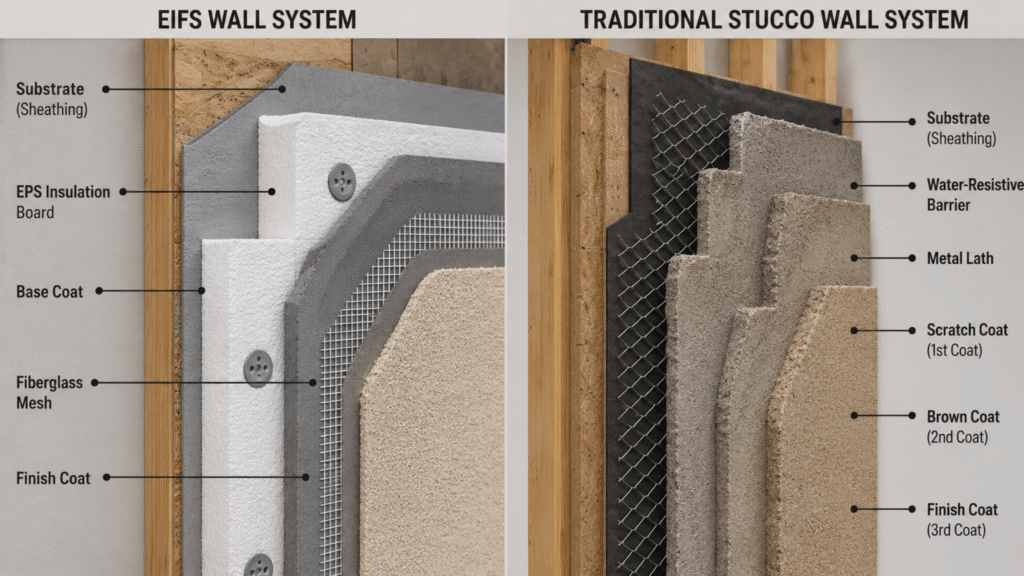
Understanding what synthetic stucco is requires understanding how it’s assembled. It’s not a single product — it’s a system with multiple layers, each serving a specific purpose.
Here’s how a standard EIFS installation breaks down:
- Substrate or sheathing — typically a water-resistive barrier (WRB) applied over the structural wall
- Expanded polystyrene (EPS) insulation board — adhesively attached or mechanically fastened to the substrate
- Base coat — a polymer-modified cementitious coating embedded with fiberglass mesh for reinforcement
- Finish coat — the outermost decorative layer, available in multiple textures and integral color options
The critical design element that separates modern EIFS from old systems is the vertical drainage plane. This is built directly into the system — typically between the insulation board and the water-resistive barrier — and it allows any moisture that penetrates the finish coat to channel downward and exit at the base rather than becoming trapped against the wall structure.
Traditional stucco does not have a drainage plane. It’s a direct-applied system — meaning it bonds tightly to the substrate with no intentional air gap or moisture drainage path. Both systems have their place, but they handle moisture in completely different ways, and that difference shapes a lot of the decisions homeowners and contractors make.
EIFS vs. Traditional 3 Coat Stucco: What’s the Difference?
This is the question most homeowners really want answered. You’ve got two stucco-like systems — which one is right for your home?
| Feature | EIFS (Synthetic Stucco) | Traditional 3 Coat Stucco |
|---|---|---|
| Primary Material | Polymer-modified acrylic | Portland cement-based |
| Insulation Included | Yes, EPS board | No |
| Drainage Plane | Yes, vertical drainage path | No |
| Finish Texture Options | High variety | Moderate variety |
| Weight | Lightweight | Heavier |
| Crack Flexibility | More flexible | More rigid |
| Typical Application | Adhesive and layered | Wire lath and scratch coat |
The traditional 3 coat stucco system consists of a scratch coat, brown coat, and finish coat applied over wire lath. Fiber mesh is only used in conjunction with wire lath applications — it reinforces the base layer and helps manage cracking stress. This system has been used successfully in Florida for generations and remains a strong, proven choice for residential and commercial exteriors.
EIFS takes a different approach. The polymer-modified base and acrylic finish coat give it a degree of flexibility that cement-based stucco simply can’t match. That flexibility makes it more forgiving with minor structural movement — but it also means the system behaves differently under impact and requires careful detailing around windows, doors, and penetrations.
Neither system is universally “better.” The right choice depends on your wall assembly, your building’s design, your location, and your performance priorities.
The Finish Options Available with EIFS
One reason synthetic stucco became popular so quickly is the design freedom it offers. The finish coat in an EIFS system can be applied in a wide range of textures, and the color is built in — not painted on top.
Integral color is a major advantage here. Because the pigment is mixed directly into the finish material, the color runs throughout the coat rather than sitting on the surface. This makes it more resistant to fading from UV exposure — a legitimate concern in Southwest Florida where sunlight is relentless. Integral color works well with both smooth and float finishes.
The most common finish textures include:
- Smooth finish — achieved through steel troweling, this creates a flat, refined surface with minimal texture variation
- Float finish — a medium texture produced by floating the surface, commonly specified for Florida homes
- Sand finish — a fine, consistent grain that’s popular for traditional Florida architecture
- Coarse or dash textures — heavier aggregate finishes with more visual depth
Each texture has its own application technique and its own aesthetic character. If you’re matching an existing exterior or trying to hit a specific architectural style, the finish selection is worth serious attention.
Why the Drainage Plane Matters So Much
If you’ve heard cautionary stories about EIFS causing moisture damage, most of them trace back to older “barrier EIFS” systems — designs that relied entirely on the exterior finish coat to keep water out, with no built-in drainage pathway. When water found its way in through cracks or poor detailing, there was nowhere for it to go. Trapped moisture against wood sheathing caused rot, mold, and structural damage.
Modern EIFS addresses this directly with the vertical drainage plane. The engineered drainage channel allows water to migrate down and out of the system rather than accumulate. This is why proper installation detailing — especially at terminations, sill pans, and penetrations — is so important. The drainage plane only works if the system is assembled correctly from start to finish.
This also explains why EIFS and traditional stucco require very different skill sets to install properly. It’s not enough to know how to apply a finish coat. You need to understand the full system, how moisture behaves inside it, and how to protect every transition point in the wall assembly.
Common Problems Homeowners See with Synthetic Stucco
No exterior cladding system is maintenance-free, and EIFS is no exception. Knowing what to watch for helps you catch problems early before they escalate.
Cracking at stress points — Window corners, door frames, and wall transitions are natural stress concentrations. Even with the flexibility advantage of acrylic-based finishes, movement over time can produce hairline cracks that need attention.
Impact damage — EIFS is softer than traditional cement stucco. Physical impact from lawn equipment, debris, or anything striking the wall can cause dents or punctures in the finish and insulation board.
Poor termination detailing — When EIFS wasn’t installed with proper sealant and flashing details at termination points, water can bypass the drainage plane entirely and work its way into the wall assembly.
Finish coat deterioration — In high-UV environments like Florida, finish coats can show chalking or color fade over time if the material quality or surface prep wasn’t adequate during installation.
When you do see stucco damage on your exterior — whether it’s EIFS or traditional stucco — acting early is almost always cheaper and simpler than waiting. Small problems in exterior cladding have a way of becoming larger structural issues when moisture gets involved.
How Stucco Crack Repairs Work
Crack repair on stucco and EIFS follows a structured process that’s meaningfully different from simply applying a patch and painting over it. Done correctly, it addresses both the visible symptom and the underlying cause.
For traditional stucco, the repair sequence involves:
- Crack chasing — widening the crack with a grinder or saw to create a clean, consistent channel for material bonding
- Sealant application — filling the prepared chase with a flexible sealant to accommodate movement and prevent water intrusion
- Stucco matching — applying patching material and finish texture that matches the existing surface as closely as possible
The texture matching step is often where repair quality shows most clearly. An experienced applicator can blend a repair into the surrounding surface so well that it becomes difficult to detect. Inconsistent texture or color variation, on the other hand, is a clear indicator that the work was rushed or performed by someone unfamiliar with finish techniques.
EIFS repairs require additional considerations because of the layered system. Damage to the finish coat, base coat, or EPS board each calls for a slightly different approach, and maintaining the integrity of the drainage plane is essential throughout the repair process.
EIFS in Southwest Florida: What You Should Know
Florida’s climate creates specific demands for any exterior cladding system. High humidity, intense UV radiation, heavy rainfall, and the occasional hurricane or tropical storm push every building material to its limits.
EIFS can perform well in this environment when it’s installed with the right system design and proper detailing. The insulation layer provides a thermal buffer that can contribute to interior comfort, which matters in a state where air conditioning accounts for a significant share of energy consumption. The acrylic finish coat handles UV reasonably well with integral color, and modern drainage-integrated designs address the moisture management challenges that older EIFS systems struggled with.
That said, installation quality is the determining factor. A well-specified and carefully installed EIFS exterior on a Fort Myers or Naples home will outperform a sloppily installed traditional stucco system every time — and the reverse is equally true. The system matters, but the hands doing the work matter more.
If you have questions about your existing exterior or want to understand what type of system you’re looking at, reaching out to an experienced stucco contractor in your area is the right starting point. The team at Cousins Stucco works across Lee and Collier Counties, including Fort Myers, Naples, and Cape Coral, providing installation and repair services for both EIFS and traditional stucco exteriors. You can contact us directly to discuss your specific situation.
Frequently Asked Questions
What is synthetic stucco made of?
Synthetic stucco, or EIFS, is made from several layers: an expanded polystyrene (EPS) insulation board, a polymer-modified cementitious base coat reinforced with fiberglass mesh, and an acrylic finish coat. The finish coat contains integral color and is available in multiple textures.
Is synthetic stucco the same as regular stucco?
No. Traditional stucco uses a Portland cement-based 3 coat system applied over wire lath. Synthetic stucco (EIFS) is a multi-layer polymer system that includes insulation and a built-in vertical drainage plane. They look similar but are fundamentally different in composition and installation method.
Does EIFS have a drainage plane?
Yes. Modern EIFS systems include a vertical drainage plane built into the assembly, positioned between the water-resistive barrier and the insulation board. This allows any moisture that penetrates the system to channel downward and exit at the base of the wall, rather than becoming trapped.
Can synthetic stucco be repaired?
Yes, EIFS can be repaired. The repair process depends on the extent and location of the damage. Surface cracks, impact damage, and finish coat deterioration all have specific repair approaches. Matching the texture and color of the existing finish is a key part of a quality repair outcome.
How long does synthetic stucco last?
When properly installed and maintained, EIFS can last 20 to 30 years or more. Performance depends heavily on installation quality, the specific system used, climate exposure, and whether minor issues like cracks or sealant failures are addressed promptly before water infiltration becomes a larger problem.
Conclusion
Synthetic stucco — EIFS — is a sophisticated, multi-layer exterior system that offers real advantages in thermal performance, design flexibility, and moisture management when it’s installed correctly. Its vertical drainage plane distinguishes it fundamentally from traditional stucco, and its acrylic finish coat opens up a wide range of texture and color options that cement-based systems simply can’t match.
Understanding what you have on your walls — or what you’re considering putting there — is the foundation of every smart exterior decision. Whether you’re dealing with an existing EIFS exterior that needs attention or exploring your options for a new construction or renovation project in Southwest Florida, knowing the difference between systems helps you ask better questions and get better results.
If your exterior needs professional stucco repair or you want an expert assessment of your current cladding system, Cousins Stucco is ready to help. Contact our team today and let’s talk about what your home actually needs.